Hun lakhon lek: the little theatre of Thai puppets
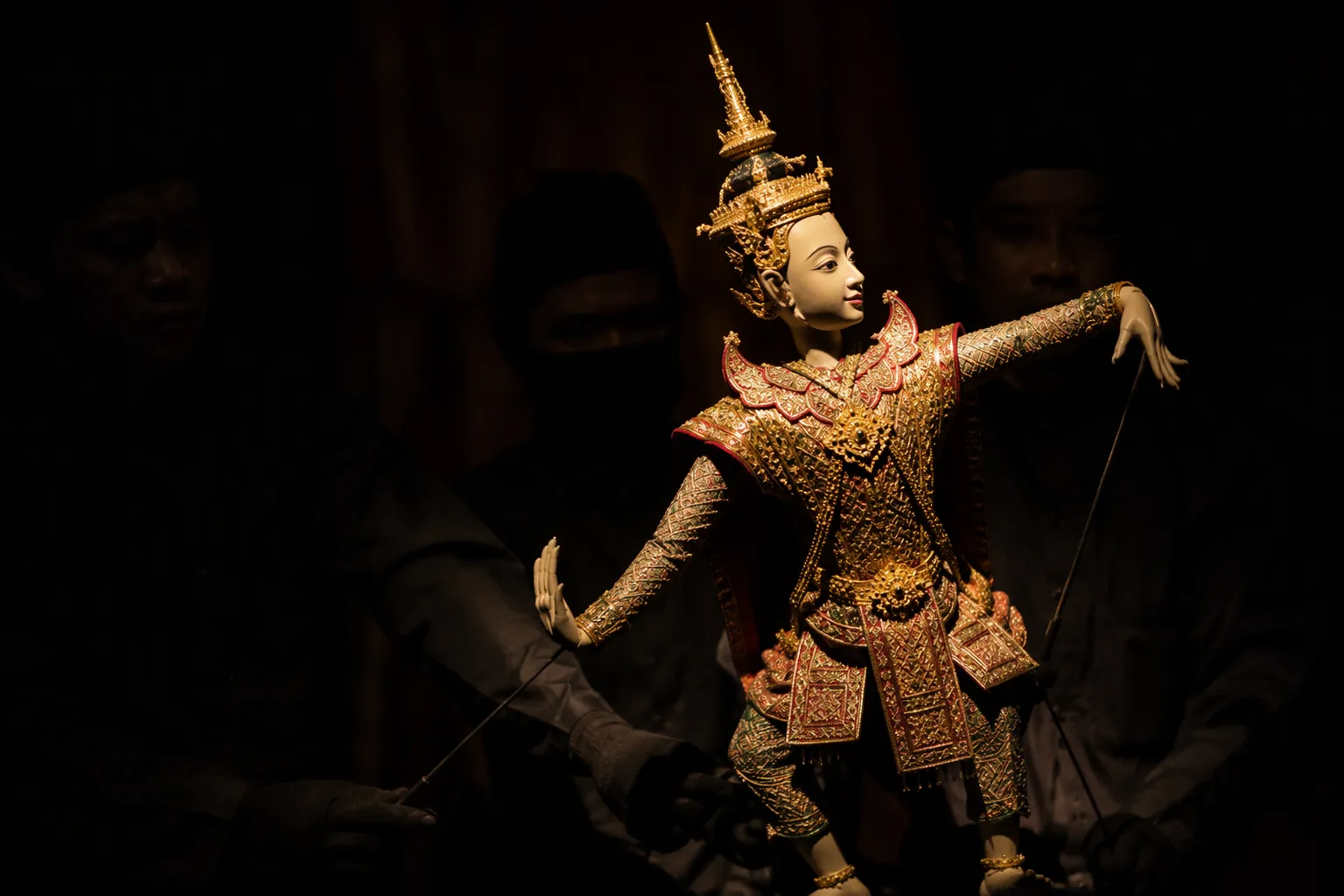
- Hun lakhon lek = Thailand's classical rod puppet theatre, performing episodes of the Ramakien.
- Each puppet takes three puppeteers: head and right arm, left arm, feet: moving as one dancer.
- Descended from the older hun krabok (bamboo rod puppet) tradition; nearly extinct by the mid-20th century.
- Survives largely through one family troupe. The most fragile of Thailand's classical stage arts.
If khon is Thailand's grand opera, hun lakhon lek is its chamber music. The same epic, played at a scale so intimate you can hear the rods creak. It is the most unlikely art in the country's theatre: a puppet the size of a child, given breath by three grown adults who must think, walk and grieve as a single body.
Scene IThree puppeteers, one body
Forget strings. A hun lakhon lek puppet, about a metre tall, costumed like a khon dancer in miniature, is moved by rigid rods, and it takes three puppeteers to operate one: the first holds the head and right arm, the second the left arm, the third the feet. They perform in full view of the audience, dressed head to toe in black, faces uncovered.
Here is the part no one expects: the puppeteers don't hide. Their own torsos become the puppet's lower body; their footsteps are its footsteps. When the puppet dances, three humans dance in perfect unison behind it, and when it weeps, three faces are quietly weeping too. Watching the black clad trio instead of the puppet for a minute is one of the great guilty pleasures of the form. The coordination takes years; a trio that has worked together a decade moves like one nervous system.
Scene IIA short history of decline
Thai puppetry is older than khon's courtly golden age, rod puppets (hun krabok) entertained both palaces and villages from at least the Ayutthaya period, performing the same Ramakien episodes as the royal dancers. The refined hun lakhon lek style crystallized in the early 20th century under court artists, most famously the master Krae Sapthavanich, whose puppets could tilt a head with genuine sorrow.
Then came the middle of the century. Cinema arrived; court patronage evaporated; puppet troupes disbanded one by one. By the 1970s the art was a rumor. A few masters, a museum's worth of rotting puppets, and no stage. Thailand nearly lost hun lakhon lek the way it nearly lost a few of its classical arts: not to protest, but to indifference.
Scene IIIThe revival, and one stubborn family
The revival has a name attached to it, and unusually for such stories, it is a puppeteer's: Sakorn Yangkheawsod, known to everyone as Joe Louis: a nickname given in childhood that stuck for life. From a family of puppeteers, he rebuilt a professional troupe in the 1980s, insisting on the full discipline: hand carved puppets, live music, Ramakien repertoire, the three person manipulation unchanged.
Recognition followed: he was named a National Artist of Thailand, and, more importantly, audiences. His Joe Louis Theatre became the one place in Bangkok where hun lakhon lek ran nightly: first at the Suan Lum Night Bazaar, then for a decade at Asiatique on the riverfront, where the signature show was the Ramakien's most beloved comic episode, Hanuman and the mermaid Suvannamaccha. The pandemic closed the Asiatique stage in 2021; the troupe has continued since in smaller venues. Sakorn died in 2022, and the family troupe carries on, which is precisely what "living tradition" means.
Scene IVWhere to see it now
This requires honesty: hun lakhon lek no longer has a permanent, tourist ready stage in Bangkok the way khon does. What exists today:
- The Joe Louis Theatre troupe continues to perform in smaller venues and at cultural events; schedules change seasonally: search current listings before planning an evening around it.
- Cultural festivals and temple fairs periodically stage hun lakhon lek and hun krabok, especially around heritage events and children's festivals.
- Short excerpts sometimes appear within larger cultural shows. A taster, not the real thing, but a legitimate first look.
Our advice: if you find a performance during your stay, rearrange things. You may be watching the last full generation of masters.
Scene VWhy it counts
Khon survived because the crown protected it; hun lakhon lek survives because individuals refused to let go. That makes it the purest expression of what the Ramakien is for: not spectacle, but inheritance. A story passed through a grandfather's hands, a carved head of wood and a child in the front row who, ten years later, might ask to learn the rods.
For the epic these puppets perform, read the Ramakien in ten scenes; for the grand masked cousin, the our khon introduction.