The Ramakien, explained in ten scenes
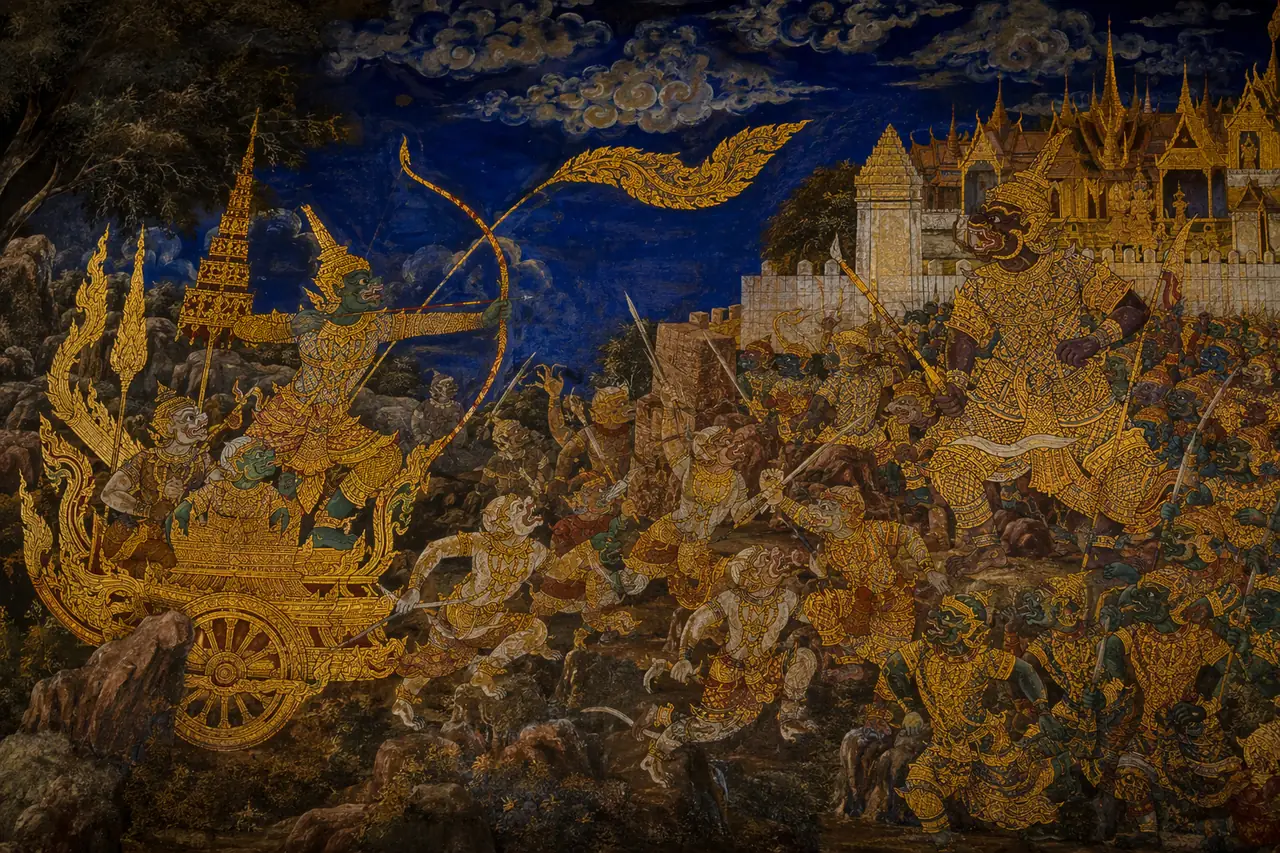
- The Ramakien is Thailand's version of the Ramayana: composed in royal verse under King Rama I in 1797, with later additions by Rama II.
- Every khon performance, most hun lakhon lek performs, and the famous Wat Phra Kaew murals all draw from it.
- Main cast: Phra Ram (hero), Nang Sida (his wife), Thotsakan (demon king), Hanuman (monkey warrior).
- Fifteen minutes with this essay will double what you get from any Thai stage performance.
Every masked dancer in Bangkok, every gilded mural at the Grand Palace, every puppet straining against its rods is telling the same story. The Ramakien is Thailand's national epic, and once you know its ten great scenes, the entire country's classical theatre stops being beautiful noise and starts being narrative.
PrologueRamayana to Ramakien
The story arrived from India centuries ago and was thoroughly remade. King Rama I commissioned the definitive Thai verse version in 1797; Rama II refined the performance texts his dancers still use. Ayodhya became Ayutthaya, Lanka became Longka, and Hanuman grew from dutiful messenger into the epic's true star: brave, magical, flirtatious and funny. The epic is not scripture in Thailand so much as shared vocabulary: a culture's library of heroes, villains and moral tests.
| Ramayana | Ramakien | Role |
|---|---|---|
| Rama | Phra Ram | The exiled hero prince |
| Sita | Nang Sida | His abducted wife |
| Ravana | Thotsakan (Tosakanth) | Ten faced demon king of Longka |
| Lakshmana | Phra Lak | Ram's loyal brother |
| Hanuman | Hanuman | White monkey warrior, son of the wind god |
The epicTen scenes
Thotsakan, ten faced and twenty armed, rules the island kingdom of Longka. Through ferocious austerity he has won near invincibility from the gods: protection against gods and demons, but not, fatally, against humans and monkeys. His growing tyranny is the engine of everything that follows.
Prince Phra Ram of Ayutthaya wins the hand of Nang Sida. Court intrigue sends the couple into fourteen years of forest exile, accompanied by Ram's loyal brother Phra Lak. The epic's tenderness lives here, and its trap is being set.
Thotsakan's niece, transformed into a dazzling golden deer, lures Ram and Lak away from their hermitage. Thotsakan approaches Sida disguised as a begging ascetic, then reveals himself and carries her off to Longka. In khon, the abduction is one of the great set pieces. The moment stillness breaks.
Searching for Sida, Ram allies with the monkey kingdom. Hanuman: son of the wind god: leaps the ocean to Longka in a single bound, finds Sida in a grove, and gives her Ram's ring as proof. Caught, he lets the demons set his tail alight, then escapes and burns Longka city with it. Audiences meet him here and love him forever.
To reach Longka, the monkey army must cross the sea. Hanuman leads the building of a stone causeway: in the telling, fish and mermaids sabotage the work by night, which is how Hanuman meets the mermaid Suvannamaccha: the flirty, crowd pleasing episode the Sala Chalermkrung khon production is built around.
Thotsakan's ally Maiyarap (the sorcerer king of the underworld) puts the entire monkey army to sleep with magic and spirits Ram away. Hanuman pursues him into the earth, kills him, and returns with the magic herb mountain: carrying an entire peak in one hand: to revive the fallen. Watch any khon battle scene and you are watching this war.
Thotsakan's brother Kumbhakarna is a giant who sleeps six months at a time and wakes with an apocalyptic appetite. Dragged to war, he devastates the monkey ranks before falling. His gigantic, tragic loyalty (he fights for a brother he knows is wrong) makes him one of the epic's most loved demons.
Brother by brother, general by general, Longka falls. At last Ram faces Thotsakan himself: the ten faced king cannot die until the arrow finds his hidden heart. When it does, the epic's long war ends in a single theatrical instant: in khon, the fall of the great gold mask.
Reunited, Ram publicly doubts Sida's fidelity during her captivity. To prove herself, Sida walks through fire, and the flames refuse to touch her. The scene is the epic's most debated: devotion vindicated, or devotion demanded unfairly. Thai audiences have argued it for two centuries; productions still play it straight to the heart.
Ram and Sida return home and the kingdom is restored. But the Ramakien, like the Ramayana before it, keeps a shadow in its final act: exile, doubt and loss trail the victory. Thai performances often close before the darkest chapters, ending in light; the full text knows better.
EpilogueWhere to meet the story in Bangkok
- Wat Phra Kaew: the cloistered galleries of the Temple of the Emerald Buddha carry 178 mural panels retelling the entire epic. Go early, walk slowly, and use this essay as your audio companion.
- Khon at Sala Chalermkrung: the masked dance drama that performs these episodes; see our khon introduction.
- Hun lakhon lek: the beloved scenes in puppet form; the puppet theatre's history is a story of its own.